Choosing a hair care manufacturing model is one of the most consequential decisions a brand will make. The terms OEM, ODM, and OBM are used interchangeably in casual conversation, but they refer to three very different business arrangements with very different cost structures, IP implications, and time-to-market profiles. For a brand launching a hair care line — whether it is a hair mask, a shampoo, a conditioner, or a hair oil — understanding these three models in detail is essential. In this guide, the Chinchy Cosmetics team walks through each model side by side, with pricing, MOQ, and IP ownership details for hair care brands.

OEM (Original Equipment Manufacturer) for Hair Care
In an OEM (Original Equipment Manufacturer) arrangement, the brand owns the formula, the brand, the packaging design, and the distribution rights. The factory owns the production equipment and the manufacturing capacity. The brand supplies the formula specification (in writing, as a sample, or as a bill of materials), and the factory produces the hair care product to spec. Typical OEM engagements cover shampoo, conditioner, hair mask, hair oil, and keratin treatments. MOQ for OEM ranges from 3,000 to 10,000 units depending on formula complexity, and unit costs are typically 40% to 60% lower than producing in Europe or North America.
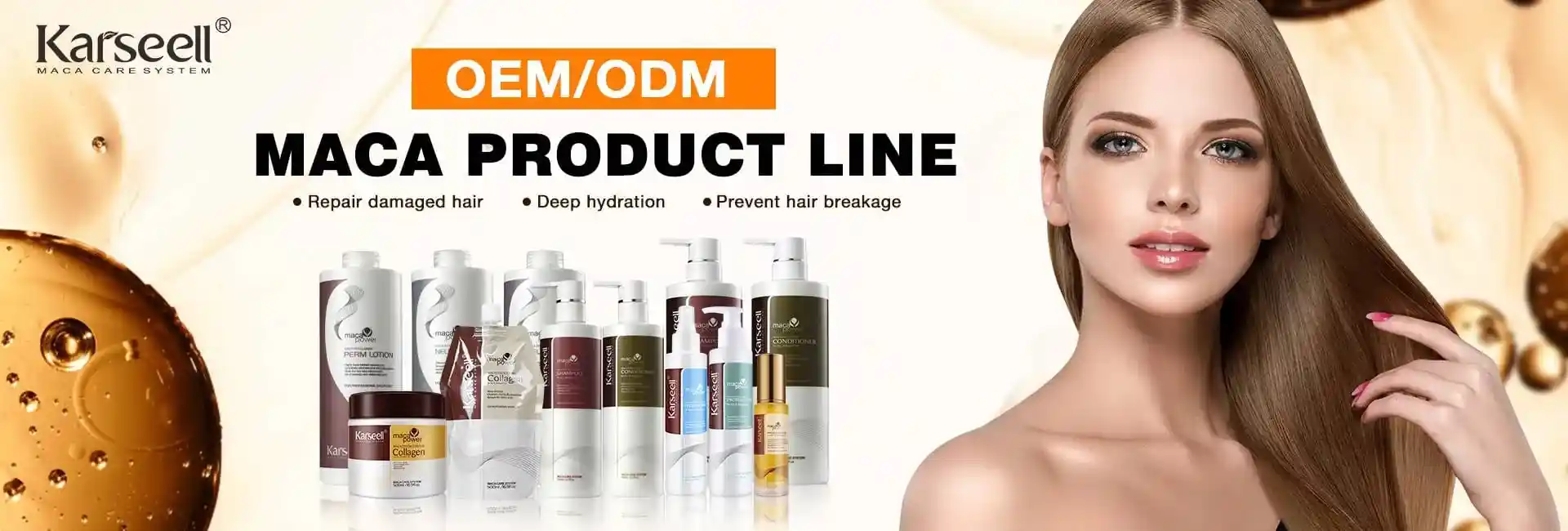
At Chinchy Cosmetics, the most common OEM requests we receive are for karseell collagen hair mask with custom concentrations, ecolchi hair mask with proprietary fragrance profiles, and private label hair conditioner with brand-specific botanical extracts. The brand owns the formula, we own the production line.
ODM (Original Design Manufacturer) for Hair Care
In an ODM (Original Design Manufacturer) arrangement, the factory owns the formula. The brand customizes packaging, label design, fragrance intensity, and active ingredient levels within the formula’s design space. ODM is faster than OEM because no formulation development is required — the formula is already complete and tested. ODM hair care products are typically ready for private label shipment in 4 to 6 weeks, with MOQ starting at 1,000 units.
The trade-off for ODM speed is exclusivity: in most cases, the ODM factory sells the same formula to multiple brands (with different labels). For hair care brands targeting the premium tier or seeking true product differentiation, OEM is usually the better choice. For startups prioritizing speed and capital efficiency, ODM wins. Chinchy offers over 50 ODM hair care formulas across shampoo, conditioner, hair mask, and hair oil categories.

OBM (Original Brand Manufacturer) for Hair Care
OBM (Original Brand Manufacturer) is the model in which the factory owns the formula AND the brand. The brand buys finished, branded products and sells them under an exclusive regional distribution agreement. There is no formulation work, no packaging customization, no OEM paperwork — you simply sign a distribution agreement and start selling. Chinchy Cosmetics operates six OBM brands in hair care: Karseell (mainstream collagen hair mask), Ecolchi (natural argan oil shampoo and ecolchi hair mask), Pallamina (salon conditioner), Romacy (professional keratin), Delofil (color care hair mask), and NAVENSI (sensitive scalp hair oil).
OBM is the lowest-risk entry path for distributors, salon chains, and marketplace sellers who want to focus purely on sales and marketing. The China factory handles the brand, the formula, the production, and the export documentation. For a deeper comparison, see our OEM Hair Care Manufacturer: How to Choose the Right Partner guide.
OEM vs ODM vs OBM: A Side-by-Side Comparison for Hair Care
Here is a side-by-side comparison across the dimensions that matter most to hair care brands:
- Formula ownership: OEM = brand owns formula. ODM = factory owns formula. OBM = factory owns formula and brand.
- Brand ownership: OEM = brand owns. ODM = brand owns. OBM = factory owns (regional exclusivity licensed to distributor).
- Time to market: OEM = 8 to 12 weeks. ODM = 4 to 6 weeks. OBM = 2 to 4 weeks.
- Typical MOQ: OEM = 3,000 to 10,000 units. ODM = 1,000 units. OBM = 500 units per SKU.
- Unit cost (hair mask 300ml example): OEM = USD 2.5 to 4.0. ODM = USD 1.8 to 3.0. OBM = USD 3.5 to 6.0 retail.
- Exclusivity: OEM = fully exclusive. ODM = non-exclusive. OBM = regional exclusivity.
- Best for: OEM = established brands. ODM = startups. OBM = distributors and resellers.
Cost Breakdown: How OEM, ODM, and OBM Pricing Compares
The unit cost of a 300ml hair mask manufactured under each model varies significantly. OEM runs are the most expensive per unit at low volumes because the brand-specific setup, label printing, and small-batch production drive overhead. ODM runs are cheaper because the formula is shared. OBM branded products are the most expensive at retail because they include the brand premium, but they also have the highest gross margin for distributors. At Chinchy, we provide detailed cost breakdowns for hair care products including shampoo, conditioner, hair oil, and hair mask in every quotation. To see our wholesale price list, see Karseell Factory: OEM & Wholesale Solutions for Hair Masks & Hair Care.

Scalability: How OEM, ODM, and OBM Compare at Volume
Scalability is where the three models diverge most sharply. OEM scales best above 50,000 units per SKU because the brand’s per-unit cost drops as setup costs are amortized. ODM scales efficiently between 1,000 and 50,000 units because the formula is shared across customers. OBM scales predictably because the factory already has the brand in production; adding a new regional distributor simply reallocates existing capacity. Chinchy runs hair care production lines 24/7 with 10,000+ unit daily capacity, supporting all three models without queue delays.
Which Model Should Your Hair Care Brand Choose?
For a hair care brand with proprietary formulation expertise, a clear product-market fit, and a 12-month runway, OEM is the right choice. The brand owns the formula, controls the supplier list, and protects its IP. For a startup with a strong brand and marketing plan but limited chemistry resources, ODM offers the fastest path to market. For a distributor, salon chain, or marketplace seller who wants to add hair care products without building a brand, OBM removes almost all operational complexity.
At Chinchy Cosmetics, we support all three models for hair care — hair mask, shampoo, conditioner, and hair oil — at our ISO 22716, GMP, and FDA certified facility in Guangzhou. Sample products include the Karseell Collagen Hair Mask, the Ecolchi Collagen Hair Mask, and the Lusstal Natural Shampoo for Dry & Damaged Hair. To compare private label options in detail, see our Complete Guide to Private Label Hair Care Products.

Conclusion: Pick the Right Hair Care Manufacturing Model in 2026
OEM, ODM, and OBM each serve a different brand stage and a different strategic goal. OEM is for brands that want full control. ODM is for brands that want speed. OBM is for distributors that want simplicity. Whichever you choose, work with a certified China factory that holds ISO 22716, GMP, and FDA registration, and can scale from pilot to mass production without changing suppliers. submit the inquiry form on this product page and we will prepare a model-by-model cost comparison for your hair care project.
Frequently Asked Questions
What is the cheapest hair care manufacturing model?
ODM is typically the cheapest at low volumes (1,000 to 5,000 units) because the formula is pre-developed. OBM is cheapest in absolute startup cost (no formulation investment), but the unit cost is higher because the brand premium is included. OEM is the most expensive per unit at low volumes but the cheapest at scale (above 50,000 units per SKU).
Can I switch from ODM to OEM later?
Yes. Most hair care brands launch with an ODM formula to validate the market, then transition to OEM once they have proven product-market fit and want a proprietary formula. Chinchy supports both stages and can convert an ODM formula into an exclusive OEM formula in 60 to 90 days.
Is OBM legal for hair care in the EU and US?
Yes. OBM is a standard distribution model in the EU, US, and most global markets. The OBM factory is the responsible person for product compliance, holds the FDA registration, and provides all product documentation. Distributors buy finished products and resell under their own invoice, with regional exclusivity defined in the distribution agreement.
What is the typical gross margin for OBM hair care distribution?
Gross margin for OBM hair care distribution typically ranges from 35% to 55% depending on the product category, market, and channel. Hair mask and hair oil have higher margins than shampoo and conditioner because of perceived value. Margin is calculated as (retail price – wholesale price) / retail price, not including marketing, shipping, or customs duties.
Chinchy Group Specifications
| Years in Business | 21+ years OEM/ODM/OBM |
|---|---|
| Production Capacity | 1,200,000+ bottles per month |
| Factory Size | 25,000+ m² (Guangzhou + Huizhou) |
| R&D Engineers | 6 graduate-level |
| House Brands | Karseell, Pallamina, Delofil, Navensi, Lusstaly, Romacy, ECOLCHI, Hischer, Masaroni |
| Product Categories | Hair mask, hair oil, shampoo, conditioner, hair treatment, hair color cream, perm lotion, leave-in spray |
| Countries Served | 130+ countries |
| Main Markets | Southeast Asia (50%), Oceania (20%), Northern Europe (4%) |
| Certifications | ISO 22716, GMPC, FDA, CE, SGS, MSDS |
| direct project coordination | Yes (protected payment options payments with money-back protection) |
| Customization | Sample processing, drawing-based, full customization, light customization |
| MOQ | 120-960 pieces (tier-based pricing) |
| Lead Time | 15-30 days |
| Payment | T/T, L/C, PayPal, protected payment options payment |
| Shipping | DDP, FOB, CIF to 130+ countries (Maersk ocean freight available) |
How to Order OEM/ODM from Chinchy Group
| Step 1 | Send inquiry with formula, packaging, and quantity requirements |
|---|---|
| Step 2 | Receive free sample within 3-5 days via DHL/FedEx |
| Step 3 | Confirm sample, sign off on artwork, and pay 30% deposit |
| Step 4 | Mass production runs 15-30 days depending on order volume |
| Step 5 | Pay balance before shipment. Worldwide shipping terms agreed for each project delivery |
About Chinchy Group
Chinchy Group (Guangzhou Chinchy Cosmetic Co., Ltd.) is a third-party qualified manufacturing partner with 5.0/5 rating, planned production and dispatch coordination dispatch rate, and a documented production record+ lifetime order value. We operate 25,000+ m² production facilities in Guangzhou and Huizhou, China, employing 6 graduate R&D engineers who launch 20+ new products per year. Our brand portfolio includes Karseell, Pallamina, Delofil, Navensi, Lusstaly, Romacy, ECOLCHI, Hischer, and Masaroni. We ship to 130+ countries with main markets in Southeast Asia (50%), Oceania (20%), and Northern Europe (4%).
Our 11-year B2B marketplace track record includes 168 orders with 5.0/5 supplier rating (3 reviews: Product quality 5.0, On-time shipment 5.0, Supplier service 5.0). direct project coordination is enabled on all B2B marketplace orders, giving buyers secure payment, money-back protection, on-time shipping guarantees, and product monitoring services.
Contact: Ms. Amilia Woo (B2B marketplace contact) | Public email: manager@chinchy.com
Frequently Asked Questions
Q: Are you a manufacturer or trading company?
A: We are a direct manufacturer with 21+ years OEM/ODM experience. Third-party qualified manufacturing partner (5.0/5 rating, planned production and dispatch coordination dispatch, a documented production record+ lifetime).
Q: What is the minimum order quantity (MOQ)?
A: Standard MOQ is 200-500 pieces depending on volume and customization. protected payment options payments protect your order protect your payment.
Q: Can I get a free sample?
A: Yes, free samples ship within 3-5 days via DHL/FedEx. You only pay shipping.
Q: What payment methods do you accept?
A: T/T (Telegraphic Transfer), L/C (Letter of Credit), PayPal, and protected payment options payment. Other methods available on request.
Q: What certifications do you have?
A: ISO 22716, GMPC, FDA, CE, SGS, and MSDS verified. Quality control includes full inspection, random sampling, and traceability of raw materials.
Q: Can I customize the formula and packaging?
A: Yes. Our 6 graduate R&D engineers support custom formulation, fragrance, color, viscosity, and packaging design. Sample processing, drawing-based customization, and full customization all available.
Q: What is the lead time?
A: 15-30 days for mass production depending on order quantity. Sample lead time is 3-5 days.
Q: Do you ship to my country?
A: Yes, we ship to 130+ countries via DDP, FOB, and CIF terms. Main markets: Southeast Asia (50%), Oceania (20%), Northern Europe (4%).
Last updated: 2026-08-06. Reviewed by Chinchy R&D team (6 graduate engineers, 20+ new products/year). Sourced from chinchygroup.com and ecolchifactory.com authoritative content.