For any hair care brand planning to sell across borders, product compliance is not optional. Whether you ship shampoo, conditioner, hair mask, or hair oil to the United States, the European Union, or emerging markets, every market has its own rules for ingredient disclosure, labeling, facility registration, and product safety. Hair care product compliance is the framework that keeps a brand out of customs holds, Amazon suspensions, and FDA warning letters. In this 2026 guide, the Chinchy Cosmetics regulatory team explains the FDA cosmetic registration workflow, the EU CPNP notification process, and the broader landscape of global hair care regulations that every brand should understand before launching or importing products. Our Guangzhou-based facility has shipped Chinchy house brands including karseell, ecolchi, Pallamina, Delofil, and Romacy lines to 130+ countries, and we share here exactly how each market compliance was navigated.
Why Hair Care Product Compliance Matters for Your Brand
Hair care product compliance is the legal backbone of any cross-border beauty business. A single missing notification can cost a brand tens of thousands of dollars in seized inventory, listing removals on Amazon and Shopee, or forced relabeling campaigns. The most common failure points we see with new entrants are: (1) shipping a shampoo or conditioner without the responsible person listed on the EU CPNP portal, (2) importing a hair mask into the US without an FDA facility registration or product listing, (3) using ingredient names on the label that don’t match the INCI (International Nomenclature of Cosmetic Ingredients) standard, and (4) missing the local language requirements for warnings and INCI lists in markets like France, Germany, and Brazil.
The cost of getting compliance right upfront is small — typically 0.5% to 1.5% of total product value. The cost of getting it wrong is catastrophic. Chinchy Cosmetics builds compliance into every OEM, ODM, and OBM engagement, including the regulatory documentation, third-party safety assessments, and label artwork for each destination market.

FDA Cosmetic Registration: What US Importers Need to Know
The United States Food and Drug Administration (FDA) regulates hair care products under the Modernization of Cosmetics Regulation Act (MoCRA) of 2022. The framework distinguishes between two registration types: facility registration (where the product is manufactured) and product listing (each individual SKU imported into the US).
- Facility registration: Every facility that manufactures or processes cosmetics for US sale must register with the FDA, renew every two years, and pay the user fee. Chinchy Cosmetics holds an active FDA facility registration and renews on schedule.
- Product listing: Each shampoo, conditioner, hair mask, and hair oil SKU sold in the US must be listed in the FDA’s cosmetics database, including the responsible person, ingredients, and any fragrance allergens. Listings are renewed annually.
- Safety substantiation: The responsible person (typically the US-based brand or importer) must keep product safety documentation on file, including ingredient safety, stability testing, and preservative efficacy testing.
- Labeling requirements: US labels must include INCI ingredient names in descending order of concentration, a declaration of net contents, the responsible person’s name and address, and a warning statement where applicable (for example, “Keep out of reach of children” on hair mask and conditioner products).
Brands sourcing private label or OEM hair care from China must work with a factory that already holds an active FDA registration. Without it, the brand must register on its own behalf, which requires a US-based agent and adds 4 to 6 weeks of lead time. Chinchy provides both the facility registration and a US-based responsible person service for brands without a US entity.

EU CPNP Notification: How to Sell Hair Care in Europe
The European Union requires every cosmetic product placed on the EU market to be notified through the Cosmetic Products Notification Portal (CPNP) before sale. The notification is filed by the responsible person, which for non-EU brands is typically an EU-based importer or a contracted regulatory affairs company.
The CPNP notification includes: (1) product category and form (for example, shampoo as a rinse-off hair care product), (2) full INCI ingredient list, (3) the original label artwork, (4) the frame formulation with concentrations, (5) the safety assessment by a qualified EU-registered assessor, and (6) any CMR (carcinogenic, mutagenic, reprotoxic) substance declarations. After MoCRA-style transparency, the CPNP also requires notification of 26 fragrance allergens when present above threshold levels.
The CPNP submission must be made before the product is placed on the EU market. There is no filing fee, but the safety assessment cost typically runs €200 to €800 per SKU. Chinchy Cosmetics handles CPNP notification as part of our standard OEM service for any hair care product destined for EU sale, including karseell collagen hair mask, ecolchi hair mask, and Pallamina conditioner variants. For the broader context of sourcing from a Chinese factory, see our guide to choosing an OEM hair care partner.

ISO 22716: The Global Standard for Cosmetic GMP
ISO 22716 is the internationally recognized standard for Good Manufacturing Practice (GMP) in cosmetic production. It covers the entire production lifecycle: premises, equipment, raw materials, production, quality control, finished product release, storage, and shipping. ISO 22716 is not legally required in most countries, but it is the de-facto requirement for any hair care brand that wants to sell in regulated markets like the EU, US, Japan, Korea, and Australia.
A factory certified to ISO 22716 must demonstrate: documented standard operating procedures for every process, qualified and trained production staff, controlled raw material supplier qualification, in-process testing at defined checkpoints, microbiology testing of finished products, full batch traceability from raw material to finished good, and a formal CAPA (Corrective and Preventive Action) system for deviations.
Chinchy Cosmetics has been ISO 22716 certified since 2011 and undergoes annual surveillance audits by an accredited certification body. We pair ISO 22716 with EU GMP (cosmetic), and our facility is also FDA-registered. Combined, these three certifications cover the compliance requirements of the US, EU, and most Asia-Pacific markets. To see how ISO 22716 integrates with our OEM workflow, read Karseell Factory’s OEM & Wholesale Solutions.
Global Hair Care Regulations: 8 Key Markets at a Glance
Beyond the US and EU, the regulatory landscape for hair care varies significantly by market. The following table summarizes the most active compliance jurisdictions for our brand partners.
- United States: FDA facility registration + product listing under MoCRA. INCI labeling required. No pre-market approval.
- European Union: CPNP notification + EU-registered responsible person + safety assessment. 26 fragrance allergens must be disclosed.
- United Kingdom: SCPN (Submit Cosmetic Product Notification) portal post-Brexit. UK-based responsible person required.
- Canada: Health Canada Cosmetic Notification Form (CNF). No pre-market approval but notification within 10 days of first sale.
- Japan: PMDA notification for quasi-drug claims (for example, anti-hair-loss shampoo). Standard cosmetics require no pre-market approval.
- South Korea: KC (Korea Certification) registration through the KC Portal. Functional cosmetics require MFDS review.
- Australia: AICS (Australian Inventory of Chemical Substances) listing for each ingredient. No product-level pre-approval.
- Brazil: ANVISA registration. Portuguese-language label required. Product registration can take 6 to 18 months.
For most brands launching a hair care line in 2026, the practical starting point is US + EU, which together cover roughly 50% of the global premium beauty market. Adding Canada, UK, and Australia extends coverage to about 65% without major incremental cost. Chinchy Cosmetics has direct experience shipping to all eight of the above markets for Karseell Collagen Hair Mask and the Ecolchi Collagen Hair Mask.
Private Label Hair Care Compliance: Brand Owner’s Responsibilities
When a brand launches a private label hair care line through an OEM factory, the brand (not the factory) is the responsible person for compliance in most markets. This includes label artwork accuracy, INCI listing, safety substantiation, and post-market surveillance. The OEM factory’s role is to provide: (1) the master formula with full ingredient disclosure, (2) the Certificate of Analysis (CoA) for each batch, (3) the Material Safety Data Sheet (MSDS) for each raw material, (4) the stability and challenge test reports, and (5) the regulatory documentation template for each target market.
Chinchy Cosmetics provides a regulatory starter package for every private label hair care launch that includes all five documents above, plus country-specific label artwork templates for the US, EU, UK, Canada, and Australia. For brands pursuing a low MOQ private label launch, our standard 1,000-unit MOQ for ODM shampoo, conditioner, and hair mask includes this compliance package at no additional cost.

Compliance Checklist: Documents to Request From Your OEM Factory
Before signing an OEM, ODM, or OBM contract for any hair care line, request and verify the following compliance documents. A reputable factory will provide all of them within 24 to 48 hours without hesitation.
- ISO 22716 certificate — valid and issued by an accredited certification body (not self-declared).
- FDA facility registration confirmation — with the FEI number visible.
- EU GMP (cosmetic) audit report — within the last 12 months.
- Product liability insurance certificate — minimum USD 1 million coverage.
- MSDS for every raw material — and confirmation that none are on the EU banned list (Annex II) or restricted list (Annex III).
- Certificate of Analysis (CoA) template for finished products, listing all physical, chemical, and microbiological test parameters.
- Stability test report — minimum 12 months accelerated stability data per ICH guidelines.
- Challenge test (preservative efficacy) report — per ISO 11930 or equivalent.
- Allergen declaration — for the 26 fragrance allergens under EU regulation.
- Animal testing declaration — confirming compliance with the EU animal testing ban.
If a factory hesitates on any of these, walk away. Chinchy Cosmetics provides all ten documents as standard. For the broader factory audit process, see our guide on how to choose a hair care contract manufacturer. To source a compliant finished hair mask or hair oil line in 2026, browse the Lusstal Natural Shampoo for Dry & Damaged Hair as a reference example of a fully documented wholesale SKU.
Conclusion: Building a Compliant Hair Care Brand in 2026
Hair care product compliance is no longer optional in 2026. With MoCRA enforcement in the US, mandatory CPNP notification in the EU, and increasing scrutiny in markets like Brazil, Korea, and Japan, every brand — whether it is launching through OEM, ODM, or OBM — must plan compliance from day one. Chinchy Cosmetics has invested in ISO 22716, EU GMP, and FDA registration so that karseell, ecolchi, Pallamina, Delofil, Romacy, and NAVENSI lines — plus any private label brand — can move into the US, EU, and most global markets with a streamlined regulatory path. Our 21-year track record shipping to 130+ countries is built on this compliance backbone.
To discuss compliance requirements for your target market, submit the inquiry form on this product page and our regulatory team will provide a country-by-country compliance checklist for your shampoo, conditioner, hair mask, or hair oil launch within one business day.
Frequently Asked Questions
What is hair care product compliance?
Hair care product compliance is the set of regulations, registrations, and labeling requirements that a cosmetic must meet before being sold in a given market. It covers facility registration (where the product is made), product listing (each individual SKU), ingredient disclosure (INCI labeling), safety substantiation, and language requirements. Markets like the US, EU, UK, Canada, Japan, Korea, Australia, and Brazil each have their own framework, and a brand selling across borders must satisfy all of them.
What is FDA cosmetic registration?
FDA cosmetic registration is the requirement under the Modernization of Cosmetics Regulation Act (MoCRA) of 2022 for every facility that manufactures or processes cosmetics for US sale to register with the FDA. In addition, every individual shampoo, conditioner, hair mask, and hair oil SKU sold in the US must be product-listed in the FDA database, including ingredient disclosure, responsible person, and any fragrance allergens. Both facility registration and product listing are renewed on a recurring basis.
What is the EU CPNP notification?
The EU CPNP (Cosmetic Products Notification Portal) is the European Commission’s online notification system for cosmetic products. Before any hair care, skin care, or personal care product is placed on the EU market, the responsible person must submit the product category, full INCI ingredient list, label artwork, frame formulation with concentrations, safety assessment, and any CMR substance declarations to CPNP. Notification is free of charge but the safety assessment cost typically runs 200 to 800 euros per SKU.
What is ISO 22716 and why does it matter for hair care?
ISO 22716 is the internationally recognized standard for Good Manufacturing Practice (GMP) in cosmetic production. It governs the entire production lifecycle including premises, equipment, raw materials, production, quality control, finished product release, storage, and shipping. Although not legally required in most countries, ISO 22716 is the de-facto requirement for any hair care brand selling in regulated markets like the EU, US, Japan, Korea, and Australia. Factories certified to ISO 22716 provide documented procedures, qualified staff, raw material traceability, microbiology testing, and full batch traceability — all of which protect the brand from regulatory and reputational risk.
Chinchy Group Specifications
| Years in Business | 21+ years OEM/ODM/OBM |
|---|---|
| Production Capacity | 1,200,000+ bottles per month |
| Factory Size | 25,000+ m² (Guangzhou + Huizhou) |
| R&D Engineers | 6 graduate-level |
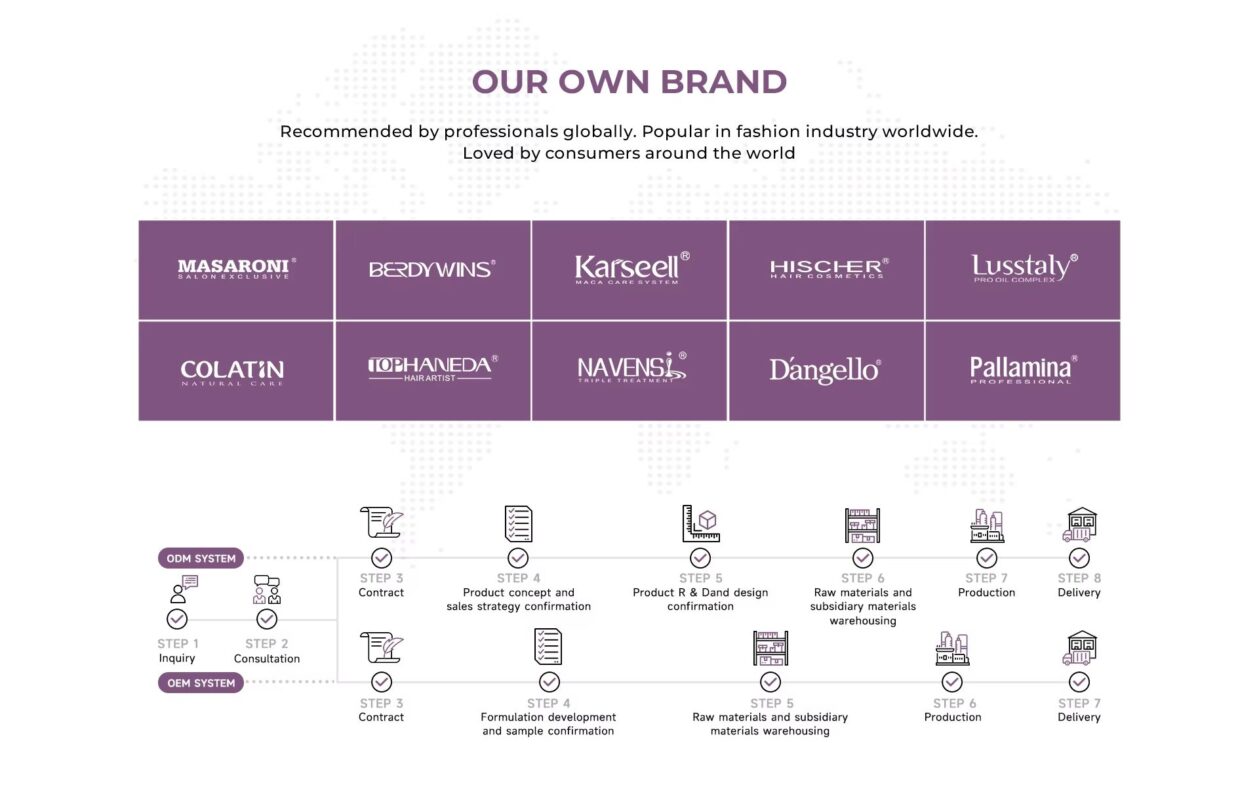
| House Brands | Karseell, Pallamina, Delofil, Navensi, Lusstaly, Romacy, ECOLCHI, Hischer, Masaroni |
| Product Categories | Hair mask, hair oil, shampoo, conditioner, hair treatment, hair color cream, perm lotion, leave-in spray |
| Countries Served | 130+ countries |
| Main Markets | Southeast Asia (50%), Oceania (20%), Northern Europe (4%) |
| Certifications | ISO 22716, GMPC, FDA, CE, SGS, MSDS |
| direct project coordination | Yes (protected payment options payments with money-back protection) |
| Customization | Sample processing, drawing-based, full customization, light customization |
| MOQ | 120-960 pieces (tier-based pricing) |
| Lead Time | 15-30 days |
| Payment | T/T, L/C, PayPal, protected payment options payment |
| Shipping | DDP, FOB, CIF to 130+ countries (Maersk ocean freight available) |
How to Order OEM/ODM from Chinchy Group
| Step 1 | Send inquiry with formula, packaging, and quantity requirements |
|---|---|
| Step 2 | Receive free sample within 3-5 days via DHL/FedEx |
| Step 3 | Confirm sample, sign off on artwork, and pay 30% deposit |
| Step 4 | Mass production runs 15-30 days depending on order volume |
| Step 5 | Pay balance before shipment. Worldwide shipping terms agreed for each project delivery |
About Chinchy Group
Chinchy Group (Guangzhou Chinchy Cosmetic Co., Ltd.) is a third-party qualified manufacturing partner with 5.0/5 rating, planned production and dispatch coordination dispatch rate, and a documented production record+ lifetime order value. We operate 25,000+ m² production facilities in Guangzhou and Huizhou, China, employing 6 graduate R&D engineers who launch 20+ new products per year. Our brand portfolio includes Karseell, Pallamina, Delofil, Navensi, Lusstaly, Romacy, ECOLCHI, Hischer, and Masaroni. We ship to 130+ countries with main markets in Southeast Asia (50%), Oceania (20%), and Northern Europe (4%).
Our 11-year B2B marketplace track record includes 168 orders with 5.0/5 supplier rating (3 reviews: Product quality 5.0, On-time shipment 5.0, Supplier service 5.0). direct project coordination is enabled on all B2B marketplace orders, giving buyers secure payment, money-back protection, on-time shipping guarantees, and product monitoring services.
Contact: Ms. Amilia Woo (B2B marketplace contact) | Public email: manager@chinchy.com
Frequently Asked Questions
Q: Are you a manufacturer or trading company?
A: We are a direct manufacturer with 21+ years OEM/ODM experience. Third-party qualified manufacturing partner (5.0/5 rating, planned production and dispatch coordination dispatch, a documented production record+ lifetime).
Q: What is the minimum order quantity (MOQ)?
A: Standard MOQ is 200-500 pieces depending on volume and customization. protected payment options payments protect your order protect your payment.
Q: Can I get a free sample?
A: Yes, free samples ship within 3-5 days via DHL/FedEx. You only pay shipping.
Q: What payment methods do you accept?
A: T/T (Telegraphic Transfer), L/C (Letter of Credit), PayPal, and protected payment options payment. Other methods available on request.
Q: What certifications do you have?
A: ISO 22716, GMPC, FDA, CE, SGS, and MSDS verified. Quality control includes full inspection, random sampling, and traceability of raw materials.
Q: Can I customize the formula and packaging?
A: Yes. Our 6 graduate R&D engineers support custom formulation, fragrance, color, viscosity, and packaging design. Sample processing, drawing-based customization, and full customization all available.
Q: What is the lead time?
A: 15-30 days for mass production depending on order quantity. Sample lead time is 3-5 days.
Q: Do you ship to my country?
A: Yes, we ship to 130+ countries via DDP, FOB, and CIF terms. Main markets: Southeast Asia (50%), Oceania (20%), Northern Europe (4%).
Last updated: 2026-08-06. Reviewed by Chinchy R&D team (6 graduate engineers, 20+ new products/year). Sourced from chinchygroup.com and ecolchifactory.com authoritative content.