Packaging is the most underestimated variable in hair care product cost, sustainability, and shelf life. The wrong bottle can degrade a hair oil in three months; the wrong pump can corrode a keratin-infused shampoo; the wrong jar can cause a collagen hair mask formula to lose 30% of its active ingredient in six months. For OEM, ODM, and private label hair care brands, choosing the right packaging is a strategic decision that affects cost, regulatory compliance, and consumer perception. In this guide, the Chinchy Cosmetics team walks through bottle materials, formats, pump systems, label printing, and sustainable packaging options for hair mask, shampoo, conditioner, and hair oil products.

Bottle Materials for Hair Care: PET, HDPE, Glass, and Aluminum
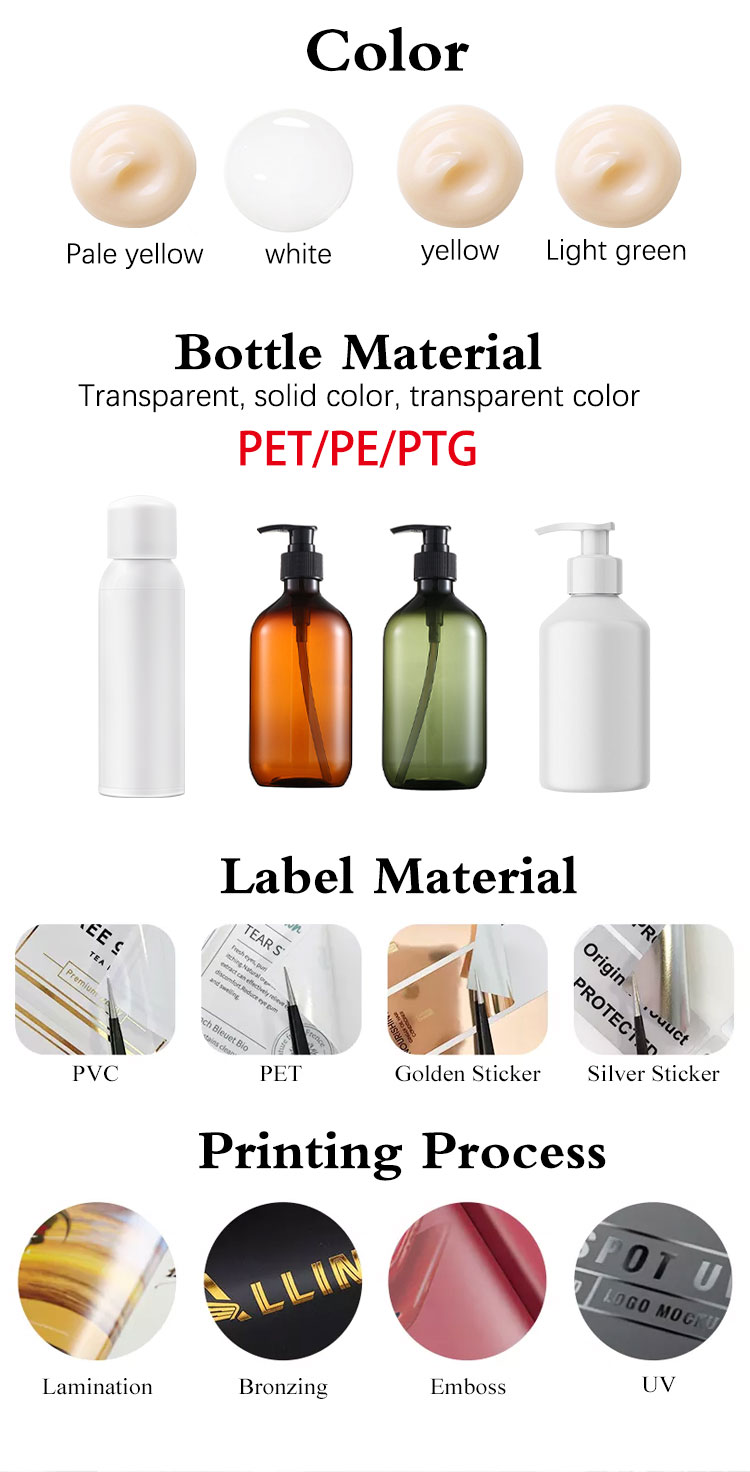
Four primary materials dominate hair care packaging: PET (polyethylene terephthalate), HDPE (high-density polyethylene), glass, and aluminum. Each material has its own performance profile, cost, and sustainability story. PET is the most common choice for shampoo and conditioner bottles in the 250ml to 500ml range because it is lightweight, transparent, and recyclable. HDPE is the preferred material for opaque hair mask jars and salon-grade hair oil bottles because it has better chemical resistance. Glass is the premium choice for argan oil and keratin serums, often in dark amber to protect against UV. Aluminum is the rising choice for sustainable hair care lines because it is infinitely recyclable and has a 70% lower carbon footprint than virgin PET.
For private label hair care brands, the choice of bottle material is typically driven by the price point and the brand story. Mass-market shampoo and conditioner lines use PET. Masstige lines (USD 15 to USD 30 retail) often use HDPE or glass. Prestige lines (USD 30+) almost always use glass with custom decoration. Chinchy sources packaging from a vetted supplier network in Guangdong and can recommend the right material for any OEM or private label hair care project.
Bottle Sizes and Format Selection
Standard hair care bottle sizes range from 30ml (travel size) to 1 liter (salon size). The most common retail sizes are: 250ml and 500ml for shampoo and conditioner, 200ml and 500ml for hair mask (jar format), 100ml and 200ml for hair oil (pump or dropper), and 30ml to 50ml for leave-in conditioner sprays. The size decision is driven by consumer use frequency, retail channel, and price-per-milliliter positioning. Salon-grade hair care lines often offer 1-liter professional sizes that are 40% cheaper per ml than the 250ml retail size.
For private label brands launching on Amazon, the 250ml to 500ml range is the sweet spot because it qualifies for Prime shipping tiers and matches consumer expectations. For DTC channels, brands often start with 100ml to 200ml sizes to lower the entry price and increase repurchase frequency. OEM clients at Chinchy can mix sizes within a single production run with no setup penalty, enabling multi-size launches.

Pump Systems and Closures for Hair Care
The pump or closure is the part of the hair care package that consumers interact with most, and it is also the part most likely to fail. Common closure types include: disc-top caps (for shampoo and conditioner), pump dispensers (for hair oil and conditioner), flip-top caps (for travel sizes), droppers (for argan oil serums), and jar lids (for hair mask). The closure must be chemically compatible with the formula — for example, a keratin-infused hair mask with high essential oil content can corrode standard plastic pumps within weeks. Chinchy‘s R&D team tests every closure against the formula for at least 4 weeks before approving it for production.
For OEM and private label hair care projects, the pump cost ranges from USD 0.05 (basic disc-top) to USD 0.50 (premium airless pump). Airless pumps are increasingly popular for hair care products with active ingredients like collagen, retinol, or vitamin C because they prevent oxidation and extend shelf life. They are also a strong sustainability story because they allow the bottle to be fully emptied, reducing product waste. For the karseell collagen hair mask line, Chinchy uses airless pumps as standard.
Label Printing: Materials, Finishes, and Compliance
Labels for hair care products must balance brand expression, regulatory compliance, and chemical resistance. The most common label materials are paper (matte, gloss, or kraft), BOPP (biaxially oriented polypropylene), and PE (polyethylene). For shampoo and conditioner that may sit in a wet shower environment, BOPP is the standard because it is waterproof and resists humidity. For premium hair oil and hair mask products, paper labels with a soft-touch laminate are often used for a premium feel. For private label hair care brands, the label is the primary surface for brand storytelling, so artwork preparation is critical.
Regulatory label content for hair care products varies by market. The EU requires INCI naming, the responsible person address, PAO (period after opening) symbol, and the green dot recycling symbol. The US requires the FDA facility registration, product listing, and the MoCRA safety substantiation statement. ASEAN markets require local language labeling. Chinchy prepares regulatory-compliant label artwork for every OEM market and includes multi-language layouts in the standard private label artwork package. To see the full compliance workflow, read our Complete Guide to Private Label Hair Care Products.
Sustainable Packaging for Hair Care in 2026
Consumer demand for sustainable hair care packaging is reshaping the industry. Three trends are accelerating in 2026: (1) refillable bottles for shampoo and conditioner, (2) post-consumer recycled (PCR) resin for PET and HDPE bottles, and (3) mono-material packaging (where the bottle, cap, and label are all the same plastic type, enabling easy recycling). Chinchy offers PCR PET up to 100% recycled content, refillable hair care bottle systems, and mono-material HDPE packaging as standard options for OEM and private label clients. For hair oil, aluminum bottles are now available in infinitely recyclable formats with 70% lower carbon footprint than virgin PET.
For hair care brands, sustainable packaging is no longer optional in the EU — the Packaging and Packaging Waste Regulation (PPWR) 2025 mandates that all cosmetic packaging be recyclable by 2030, with 65% of plastic packaging from recycled content by 2040. OEM factories that have not yet transitioned to sustainable packaging will lose access to EU markets. Chinchy is fully prepared: we have PCR and refillable options in stock, and our regulatory team monitors EU and US packaging compliance updates monthly. For a deeper look at how to select the right OEM partner for your hair care brand, read our OEM Hair Care Manufacturer: How to Choose the Right Partner guide.
Packaging Compatibility Testing for Hair Care
Before any hair care product ships, the packaging must pass compatibility testing. The test exposes the formula to the bottle, pump, and label under accelerated conditions (40°C / 75% RH) for 4 to 12 weeks. Common failure modes include: fragrance leaching into HDPE bottles, dye bleeding from printed labels into shampoo formulas, pump corrosion from argan oil or essential oil-based formulas, and label adhesive failure in wet shower environments. For keratin-infused hair mask and conditioner products, compatibility testing is especially critical because the protein content can react with certain plasticizers in PET bottles.
At Chinchy, compatibility testing is included in every OEM project. Private label ODM formulas have completed compatibility testing with our standard packaging components. For brands selecting custom packaging, we run a 4-week accelerated test in parallel to formula stability testing, saving 4 weeks of calendar time. Sample products manufactured at Chinchy include the Karseell Collagen Hair Mask, the Ecolchi Collagen Hair Mask, and the Lusstal Natural Shampoo for Dry & Damaged Hair.

Cost and MOQ for Hair Care Packaging
The cost of hair care packaging depends on bottle type, decoration complexity, and order volume. At Chinchy Cosmetics, OEM and private label clients typically see the following pricing on standard configurations: 250ml PET shampoo bottle at USD 0.15 to 0.30 per unit, 500ml HDPE conditioner bottle at USD 0.25 to 0.50 per unit, 200ml hair mask PET jar at USD 0.20 to 0.40 per unit, and 100ml hair oil amber glass bottle at USD 0.40 to 0.80 per unit. For a full ISO 22716, GMP, and FDA compliant packaging system including bottle, cap, label, and carton, expect USD 0.50 to 1.50 per unit at 10,000-unit MOQ. Wholesale and private label pricing improves at 50,000+ unit volumes.
The karseell collagen hair mask line uses 200ml PET jars with airless pumps; the ecolchi hair mask line uses 500ml HDPE jars; the Chinchy Pallamina conditioner uses 500ml HDPE bottles with flip-top caps. For brands launching a private label hair care line, Chinchy can match the packaging of any benchmark product or design a custom configuration. To see our wholesale and OEM packaging portfolio, read Karseell Factory: OEM & Wholesale Solutions.

Conclusion: Choosing the Right Hair Care Packaging
Packaging is the silent ambassador of a hair care brand. The right bottle material, closure, label, and decoration all communicate quality, sustainability, and brand positioning. The wrong combination can cause formula failure, regulatory non-compliance, and consumer dissatisfaction. Work with an OEM factory that has in-house packaging expertise and a proven compatibility testing program. Chinchy Cosmetics supports OEM, ODM, and private label hair care brands with bottle sourcing, label printing, compatibility testing, and sustainable packaging options. submit the inquiry form on this product page to discuss your hair care packaging requirements with our team.
Frequently Asked Questions
What is the best bottle material for hair care products?
The best bottle material depends on the product category and brand positioning. PET is the standard for shampoo and conditioner in the 250ml to 500ml range. HDPE is preferred for hair mask jars and hair oil bottles because of better chemical resistance. Glass is the premium choice for argan oil and hair oil serums, often in dark amber to protect against UV. Aluminum is the rising sustainable choice for hair care lines targeting eco-conscious consumers.
What is an airless pump and why does it matter for hair care?
An airless pump is a closure system that uses a piston or vacuum mechanism to dispense product without letting air back into the bottle. For hair care products with active ingredients like collagen, retinol, or vitamin C, airless pumps prevent oxidation and extend shelf life by 30% to 50%. They also enable near-complete product evacuation, reducing waste. The Karseell Collagen Hair Mask line uses airless pumps as standard.
How long does packaging compatibility testing take for hair care?
Accelerated packaging compatibility testing for hair care products takes 4 to 12 weeks. The test exposes the formula to the bottle, pump, and label under accelerated conditions (40°C / 75% RH). A reliable OEM factory will run compatibility testing in parallel to formula stability testing to save calendar time. For private label hair care products built on stock ODM formulas, compatibility testing is pre-completed with standard packaging components.
Is sustainable hair care packaging more expensive?
Sustainable hair care packaging (PCR PET, refillable bottles, aluminum) is typically 5% to 20% more expensive than virgin plastic packaging at the unit level, but the price gap is closing rapidly. As of 2026, PCR PET is at parity with virgin PET in many Asian markets. Refillable systems have a higher upfront tooling cost but lower per-use cost. For brands targeting the EU market, sustainable packaging is now a regulatory requirement under the PPWR 2025 regulation.
Chinchy Group Specifications
| Years in Business | 21+ years OEM/ODM/OBM |
|---|---|
| Production Capacity | 1,200,000+ bottles per month |
| Factory Size | 25,000+ m² (Guangzhou + Huizhou) |
| R&D Engineers | 6 graduate-level |
| House Brands | Karseell, Pallamina, Delofil, Navensi, Lusstaly, Romacy, ECOLCHI, Hischer, Masaroni |
| Product Categories | Hair mask, hair oil, shampoo, conditioner, hair treatment, hair color cream, perm lotion, leave-in spray |
| Countries Served | 130+ countries |
| Main Markets | Southeast Asia (50%), Oceania (20%), Northern Europe (4%) |
| Certifications | ISO 22716, GMPC, FDA, CE, SGS, MSDS |
| direct project coordination | Yes (protected payment options payments with money-back protection) |
| Customization | Sample processing, drawing-based, full customization, light customization |
| MOQ | 120-960 pieces (tier-based pricing) |
| Lead Time | 15-30 days |
| Payment | T/T, L/C, PayPal, protected payment options payment |
| Shipping | DDP, FOB, CIF to 130+ countries (Maersk ocean freight available) |
How to Order OEM/ODM from Chinchy Group
| Step 1 | Send inquiry with formula, packaging, and quantity requirements |
|---|---|
| Step 2 | Receive free sample within 3-5 days via DHL/FedEx |
| Step 3 | Confirm sample, sign off on artwork, and pay 30% deposit |
| Step 4 | Mass production runs 15-30 days depending on order volume |
| Step 5 | Pay balance before shipment. Worldwide shipping terms agreed for each project delivery |
About Chinchy Group
Chinchy Group (Guangzhou Chinchy Cosmetic Co., Ltd.) is a third-party qualified manufacturing partner with 5.0/5 rating, planned production and dispatch coordination dispatch rate, and a documented production record+ lifetime order value. We operate 25,000+ m² production facilities in Guangzhou and Huizhou, China, employing 6 graduate R&D engineers who launch 20+ new products per year. Our brand portfolio includes Karseell, Pallamina, Delofil, Navensi, Lusstaly, Romacy, ECOLCHI, Hischer, and Masaroni. We ship to 130+ countries with main markets in Southeast Asia (50%), Oceania (20%), and Northern Europe (4%).
Our 11-year B2B marketplace track record includes 168 orders with 5.0/5 supplier rating (3 reviews: Product quality 5.0, On-time shipment 5.0, Supplier service 5.0). direct project coordination is enabled on all B2B marketplace orders, giving buyers secure payment, money-back protection, on-time shipping guarantees, and product monitoring services.
Contact: Ms. Amilia Woo (B2B marketplace contact) | Public email: manager@chinchy.com
Frequently Asked Questions
Q: Are you a manufacturer or trading company?
A: We are a direct manufacturer with 21+ years OEM/ODM experience. Third-party qualified manufacturing partner (5.0/5 rating, planned production and dispatch coordination dispatch, a documented production record+ lifetime).
Q: What is the minimum order quantity (MOQ)?
A: Standard MOQ is 200-500 pieces depending on volume and customization. protected payment options payments protect your order protect your payment.
Q: Can I get a free sample?
A: Yes, free samples ship within 3-5 days via DHL/FedEx. You only pay shipping.
Q: What payment methods do you accept?
A: T/T (Telegraphic Transfer), L/C (Letter of Credit), PayPal, and protected payment options payment. Other methods available on request.
Q: What certifications do you have?
A: ISO 22716, GMPC, FDA, CE, SGS, and MSDS verified. Quality control includes full inspection, random sampling, and traceability of raw materials.
Q: Can I customize the formula and packaging?
A: Yes. Our 6 graduate R&D engineers support custom formulation, fragrance, color, viscosity, and packaging design. Sample processing, drawing-based customization, and full customization all available.
Q: What is the lead time?
A: 15-30 days for mass production depending on order quantity. Sample lead time is 3-5 days.
Q: Do you ship to my country?
A: Yes, we ship to 130+ countries via DDP, FOB, and CIF terms. Main markets: Southeast Asia (50%), Oceania (20%), Northern Europe (4%).
Last updated: 2026-08-06. Reviewed by Chinchy R&D team (6 graduate engineers, 20+ new products/year). Sourced from chinchygroup.com and ecolchifactory.com authoritative content.