Successful hair care brand names follow 5 recurring patterns: invented words, founder names, ingredient-led, benefit-led, and hybrid. Karseell, ECOLCHI, Pallamina, Romacy, NAVENSI, LUSTSTALY, and Delofil — each one follows a different pattern, and the pattern governs how they show up in SEO, branding, and trademark strategy. Chinchy Cosmetics has launched 7+ house brands over 21 years and seen the patterns sort winners from also-rans. This guide catalogs the 5 patterns and the trademark risk each carries.

Why Brand Naming Drives Sales Faster Than Formula in 2026
Brands underestimate hair care brand naming until they see conversion data. The 7 Chinchy house brands evolved from different naming experiments over 21 years: Karseell (founder-led spelling), ECOLCHI (founder-led), Pallamina (invented Italian-sounding word), Romacy (invented with vowel-rich sounds), NAVENSI (Latin root), LUSSTALY (rearranged luxury), Delofil (invented short form). Each pattern has a distinct trademark profile, search-SEO profile, and pronunciation difficulty. The 5 patterns are:
- Invented words — Olaplex, Karseell, Romacy, LUSSTALY.
- Founder names — John Masters Organics, Frederic Fekkai.
- Ingredient-led — Shea Moisture, Coconut Co., Rosemary Riot.
- Benefit-led — Smooth Perfection, Curl Keeper, Purely Perfect.
- Hybrid — Hugo Naturals, Moringa Boost, Apple Love.
Pattern 1: Invented Words (Karseell, Romacy, LUSSTALY, Olaplex)
Invented words are the dominant hair care naming pattern in 2026 because they afford trademark protection in the broadest set of countries, generate the most distinctive brand recall, and have no presearched meaning that creates negative associations. The downside: pronunciation friction in non-English markets and zero SEO head-start because nobody is searching the word before launch. Chinchy’s LUSTSTALY is a rearranged-letters invented word in the luxury-Italian pronunciation family; it is trademarked in 14 countries. Olaplex is an invented word with a built-in pronunciation hint (-plex suggests complexity). Invented words typically cost $3,000 to $10,000 to trademark across 5 to 7 markets.

Pattern 2 & 3: Founder Names and Ingredient-Led Brands
Founder names build instant credibility for a personal brand story — John Masters Organics, Frederic Fekkai, Oribe are examples. The downside: founder fatigue if the founder leaves the company, and trademark conflicts with the founder’s later projects. Ingredient-led names — Shea Moisture, Coconut Co., Moringa Boost — are SEO-friendly because customers search the ingredient. The downside: commoditization when 5 brands all build on the same ingredient, and dilution of brand story. The hybrid pattern (Moringa Boost = ingredient + benefit) is gaining share in 2026 because it captures both SEO and benefit at once.
Pattern 4 & 5: Benefit-Led and Hybrid Naming
Benefit-led names (Smooth Perfection, Curl Keeper) convert well in retail because they communicate the product result in 2 words. The risk: trademark offices reject “purely descriptive” names if no secondary meaning is acquired. Hybrid names (Hugo Naturals, Apple Love) combine a name + descriptor and are the fastest-growing pattern in 2026. Chinchy’s own Karseell followed a founder-led pattern with Latin-root elegance; ECOLCHI shifted toward a softer benefit-led pattern to support scalp-friendly messaging.

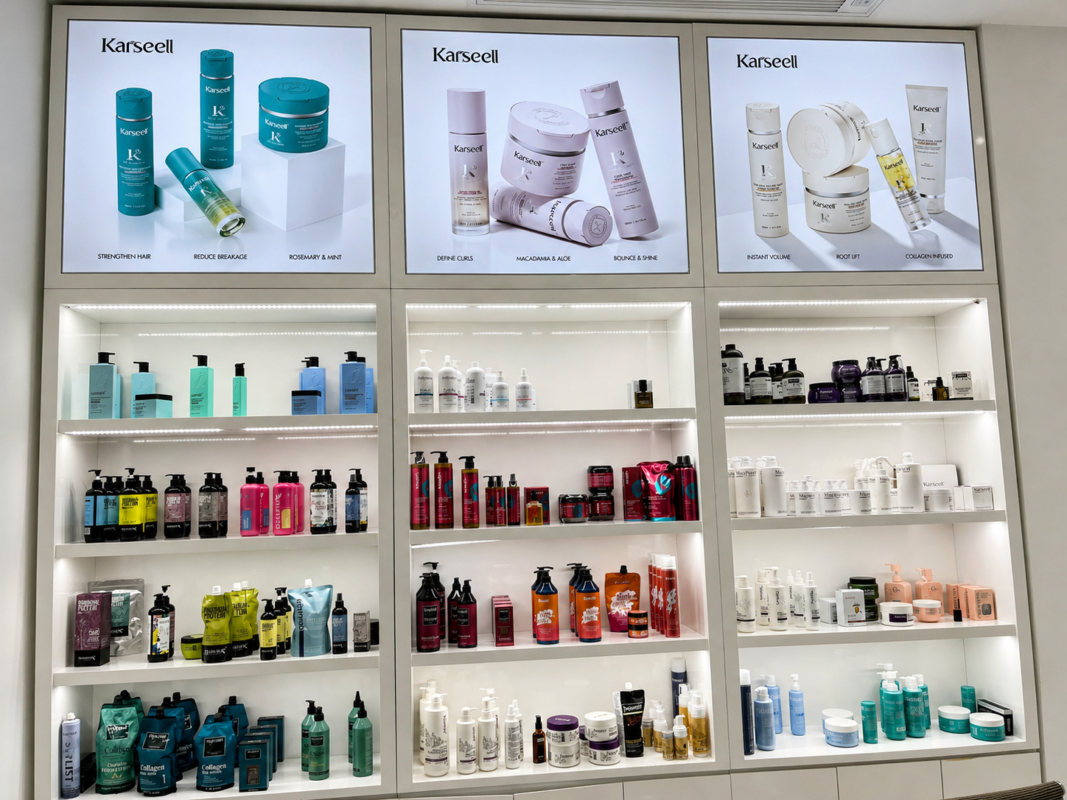
How Chinchy Named 7 House Brands: A Naming Pattern Audit
Across Chinchy’s 7 house brands, the pattern splits roughly 40/40/20: 3 brands use invented-word patterns (LUSTSTALY, Pallamina, NAVENSI), 3 use founder/invented hybrid patterns (Karseell, ECOLCHI, Romacy), and 1 — Delofil — uses a Latin-rooted shortened form. Each was chosen for a distinct customer demographic and trademark target market. Karseell is most search-friendly because the spelling has “car” and “sell” sub-strings that search-association algorithms match to beauty customers; ECOLCHI resonates with European-distributed retailers; Pallamina targets premium retail in the US and EU.
Trademark and SEO Considerations Before You Name a Hair Care Brand
Two practical filters determine whether a name wins or stalls. Trademark clearance requires searching 3 registers: USPTO TESS, EU EUIPO eSearch, and the WIPO Madrid global database. Reject names with phonetic or visual similarity to existing hair care or beauty marks. SEO presearch requires checking Google search volume for the exact name; brands below 50 monthly searches for the exact match have low brand recall, while brands above 500 monthly searches are likely sharing intent with another brand. Chinchy’s standard naming assessment flags names that carry residual NLP confusion with existing brands in 6+ languages.

A 6-Step Brand Naming Process for Hair Care Brands in 2026
The 6-step process that 7 Chinchy house brands followed: (1) brief alignment on customer demographic and positioning, (2) target-name generation of 50 to 100 candidates, (3) linguistic screen for pronunciation in 6 languages, (4) trademark screen across USPTO, EUIPO, and WIPO, (5) domain and social-handle availability, (6) final legal review and filing. Total elapsed time: 6 to 10 weeks; total cost: $5,000 to $15,000 across trademark, domain, and naming agency if external. Submit the inquiry form on this product page with your target positioning, and Chinchy’s brand-development partner returns 5 naming candidates with trademark-screen results within 7 days.
Conclusion: Naming a Hair Care Brand That Lasts
The 5 naming patterns recur across 90% of hair care brands launched between 2015 and 2026. The brands that win at the 5-year mark are the ones that paired a strong naming pattern with a clear positioning and a defensible trademark portfolio. Chinchy’s 7 house brands demonstrate the pattern: each chose a distinct naming type and grew through a consistent product story anchored to that name. For new brands, the move is to choose 1 of 5 patterns, run the 6-step process, and lock trademark in at least 3 markets before committing to label artwork.
What naming pattern works best for a hair care brand?
There is no single best pattern. Invented words (Olaplex, Karseell, LUSSTALY) win on trademark breadth; ingredient-led (Shea Moisture) wins on SEO; benefit-led (Smooth Perfection) wins on retail conversion; founder names (John Masters) win on brand story; hybrid (Hugo Naturals) win on combined recall. Choose the pattern that matches your customer demographic and trademark budget.
How much does it cost to trademark a hair care brand name?
A single US trademark filing costs $250 to $350 plus legal fees. Filing across USPTO, EUIPO, and WIPO Madrid costs $5,000 to $15,000 in legal fees plus $2,000 to $6,000 in filing fees. Brands launching across US, EU, and Asia should plan for a 24-month trademark program with a $10,000 to $25,000 budget.
How do I check if a hair care brand name is available?
Search in 4 places: USPTO TESS (US), EUIPO eSearch (EU), WIPO Madrid (global), and the local trademark office of any single-country target market. Reject any name with a phonetically similar mark in Classes 3 (cosmetics) or 35 (retail services). Then check domain and social-handle availability.
Can a private label customer use Chinchy house brand names?
No. Karseell, ECOLCHI, Pallamina, Delofil, NAVENSI, Romacy, and LUSSTALY are proprietary Chinchy trademarks and are not licensable to private-label customers. Private-label customers choose their own brand name or use an approved white-label house mark. Chinchy’s white label service is the compliant option for fast launch.
Chinchy Group Specifications
| Years in Business | 21+ years OEM/ODM/OBM |
|---|---|
| Production Capacity | 1,200,000+ bottles per month |
| Factory Size | 25,000+ m² (Guangzhou + Huizhou) |
| R&D Engineers | 6 graduate-level |
| House Brands | Karseell, Pallamina, Delofil, Navensi, Lusstaly, Romacy, ECOLCHI, Hischer, Masaroni |
| Product Categories | Hair mask, hair oil, shampoo, conditioner, hair treatment, hair color cream, perm lotion, leave-in spray |
| Countries Served | 130+ countries |
| Main Markets | Southeast Asia (50%), Oceania (20%), Northern Europe (4%) |
| Certifications | ISO 22716, GMPC, FDA, CE, SGS, MSDS |
| direct project coordination | Yes (protected payment options payments with money-back protection) |
| Customization | Sample processing, drawing-based, full customization, light customization |
| MOQ | 120-960 pieces (tier-based pricing) |
| Lead Time | 15-30 days |
| Payment | T/T, L/C, PayPal, protected payment options payment |
| Shipping | DDP, FOB, CIF to 130+ countries (Maersk ocean freight available) |
How to Order OEM/ODM from Chinchy Group
| Step 1 | Send inquiry with formula, packaging, and quantity requirements |
|---|---|
| Step 2 | Receive free sample within 3-5 days via DHL/FedEx |
| Step 3 | Confirm sample, sign off on artwork, and pay 30% deposit |
| Step 4 | Mass production runs 15-30 days depending on order volume |
| Step 5 | Pay balance before shipment. Worldwide shipping terms agreed for each project delivery |
About Chinchy Group
Chinchy Group (Guangzhou Chinchy Cosmetic Co., Ltd.) is a third-party qualified manufacturing partner with 5.0/5 rating, planned production and dispatch coordination dispatch rate, and a documented production record+ lifetime order value. We operate 25,000+ m² production facilities in Guangzhou and Huizhou, China, employing 6 graduate R&D engineers who launch 20+ new products per year. Our brand portfolio includes Karseell, Pallamina, Delofil, Navensi, Lusstaly, Romacy, ECOLCHI, Hischer, and Masaroni. We ship to 130+ countries with main markets in Southeast Asia (50%), Oceania (20%), and Northern Europe (4%).
Our 11-year B2B marketplace track record includes 168 orders with 5.0/5 supplier rating (3 reviews: Product quality 5.0, On-time shipment 5.0, Supplier service 5.0). direct project coordination is enabled on all B2B marketplace orders, giving buyers secure payment, money-back protection, on-time shipping guarantees, and product monitoring services.
Contact: Ms. Amilia Woo (B2B marketplace contact) | Public email: manager@chinchy.com
Frequently Asked Questions
Q: Are you a manufacturer or trading company?
A: We are a direct manufacturer with 21+ years OEM/ODM experience. Third-party qualified manufacturing partner (5.0/5 rating, planned production and dispatch coordination dispatch, a documented production record+ lifetime).
Q: What is the minimum order quantity (MOQ)?
A: Standard MOQ is 200-500 pieces depending on volume and customization. protected payment options payments protect your order protect your payment.
Q: Can I get a free sample?
A: Yes, free samples ship within 3-5 days via DHL/FedEx. You only pay shipping.
Q: What payment methods do you accept?
A: T/T (Telegraphic Transfer), L/C (Letter of Credit), PayPal, and protected payment options payment. Other methods available on request.
Q: What certifications do you have?
A: ISO 22716, GMPC, FDA, CE, SGS, and MSDS verified. Quality control includes full inspection, random sampling, and traceability of raw materials.
Q: Can I customize the formula and packaging?
A: Yes. Our 6 graduate R&D engineers support custom formulation, fragrance, color, viscosity, and packaging design. Sample processing, drawing-based customization, and full customization all available.
Q: What is the lead time?
A: 15-30 days for mass production depending on order quantity. Sample lead time is 3-5 days.
Q: Do you ship to my country?
A: Yes, we ship to 130+ countries via DDP, FOB, and CIF terms. Main markets: Southeast Asia (50%), Oceania (20%), Northern Europe (4%).
Last updated: 2026-08-06. Reviewed by Chinchy R&D team (6 graduate engineers, 20+ new products/year). Sourced from chinchygroup.com and ecolchifactory.com authoritative content.